

The Puzzle
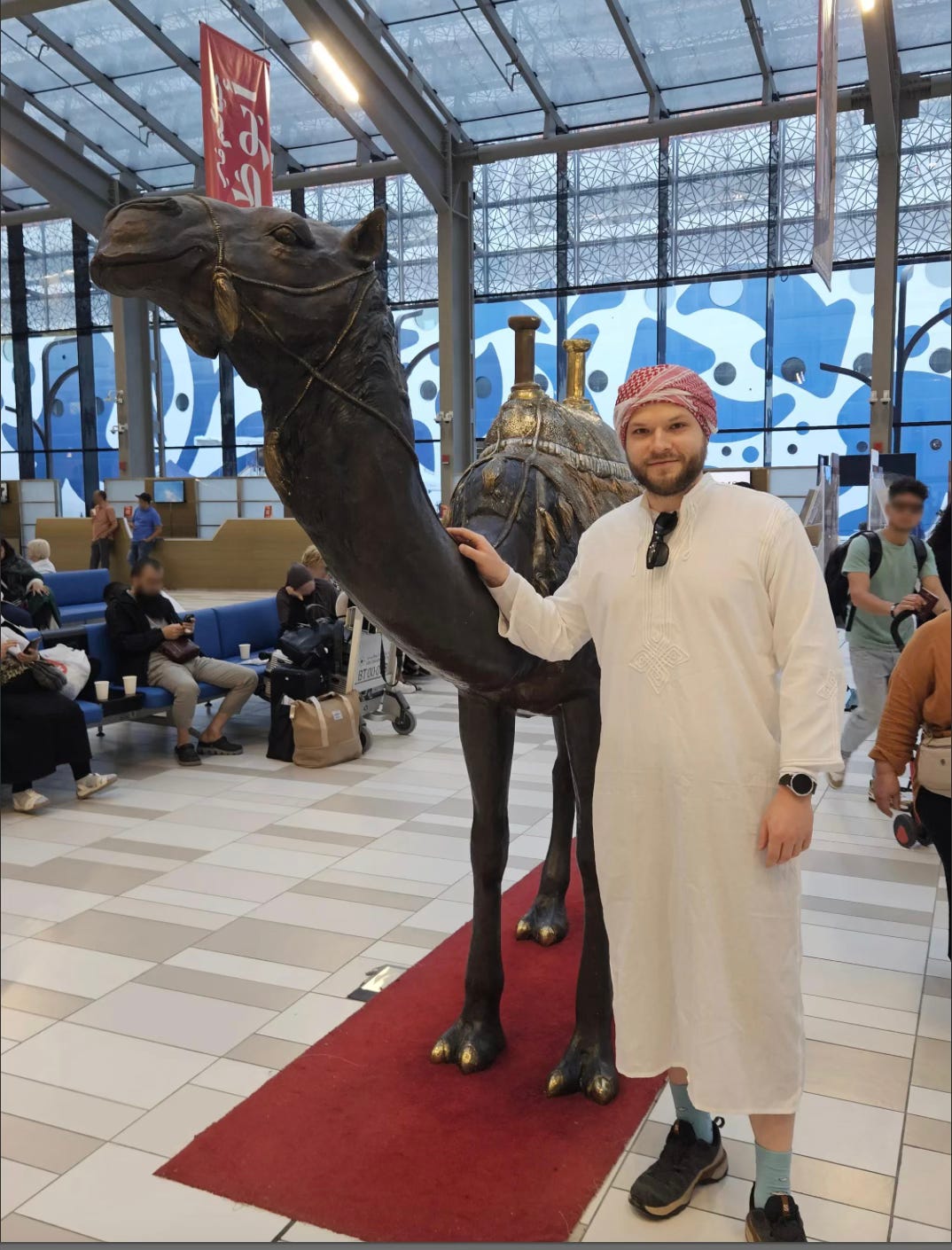
I’ll admit this one nearly tripped me up right out of the gate. The image dropped into the monthly Bellingcat Discord challenge channel with a three-part tasking: find the exact location, name the mode of transport, and identify the specific vehicle or vessel hanging out in the background.
Looking at the photo, everything about it screamed “airport.” You’ve got the massive steel ceiling trusses, rows of blue tandem seating, baggage trolleys, and people wandering around with backpacks. There’s even a massive red banner hanging from the ceiling with Arabic script. It looked like a classic, straightforward aviation geolocation. But if OSINT teaches you anything, it’s that the moment you feel certain based on a five-second glance is exactly when you’re about to tank the challenge.
Deconstructing the Problem
To avoid spinning my wheels, I broke the setter’s prompt down into the three actual questions that needed answers:
Where exactly was this photo taken?
What kind of transit hub is this?
What is the specific identity of that blue-and-white patterned thing out the window?
Instead of just hunting for things that matched my first impression, I forced myself to look for anomalies—things that didn’t fit the “airport” narrative. It’s a basic habit that separates structured analysis from just aimlessly googling clues, and it saves an immense amount of time.
First Read: The Airport False Start
An honest write-up means admitting the dead ends. My brain instantly anchored on the idea of a major Middle Eastern flight hub.
I started by isolating that red banner in the background. After rotating the crop to read the vertical text, the Arabic script translated directly to “Abu Dhabi.”
Perfect, I thought. Abu Dhabi has a massive, brand-new aviation landmark: Terminal A at Abu Dhabi International Airport. It features the same kind of undulating steel beams and expansive glass facades. I spent a good forty minutes combing through passenger vlogs, travel blogs, and interior photos of Terminal A, completely convinced I’d spot that bronze camel on its red carpet. I was deep in my own confirmation bias, actively trying to force the terminal’s geometry to fit the photo.
The Pivot: Catching the Bias
The breakthrough happened when I stopped looking at the camel and started looking at the background flaws in my theory. Two things broke the airport hypothesis completely.
First, look at the windows. They are strictly vertical and linear. They completely lacked the dramatic, organic sweeping curves that define Abu Dhabi’s Terminal A roofline. Second, and more importantly, look through the glass. That isn’t an open tarmac or a runway out there. It’s a solid, towering wall of vibrant blue and white abstract patterns sitting just a few meters from the glass.
I’d fallen straight into an anchoring bias—clinging to the first logical idea (baggage carts and seating equals airport) and ignoring everything else.
When I zoomed in on that blue pattern, the penny dropped. It wasn’t a building next door, and it wasn’t a decorative window film. It was the side of a massive ship hull. This wasn’t an airport terminal; it was a cruise terminal.
Switching gears to maritime infrastructure in the UAE, I looked up Abu Dhabi’s cruise facilities. The Zayed Port Cruise Terminal (also known as Marsa Meyas) was an identical match. The linear ceiling trusses, the blue plastic seats, and the geometric lattice patterning on the upper window panes all aligned perfectly. The camel had a home.
Identifying the Ship
With the location locked down to Zayed Port, the next task was identifying the exact ship parked outside. That blue-and-white hull art was incredibly distinct—it looked like abstract coral branches or waves cutting across the traditional white of a cruise liner.
I ran through the usual suspects for cruise line liveries:
AIDA: Nope. They do the giant lips and eyes on the bow.
Norwegian (NCL): They love colorful hull art, but theirs are usually multi-colored and chaotic. This was a strict, dual-tone corporate blue.
MSC Cruises: Their fleet is famously all-white, but a quick search revealed they recently started wrapping their newest LNG-powered flagships in full-hull environmental designs.
A targeted search for MSC’s blue-wrapped ships immediately pulled up the MSC Euribia. The massive, flowing sea-life graphics matched the exact shapes, curves, and color gradients visible through the terminal windows.
Fact-Checking the Deployment
To verify the match, I needed to make sure the ship actually operates in this part of the world. A check of MSC’s published itineraries and industry reporting confirmed that MSC Euribia was explicitly deployed to the Arabian Gulf for the winter 2025/2026 season. The cruise line had positioned the ship there for a dedicated series of regional winter sailings operating directly out of Dubai and Abu Dhabi. The timeline and geography lined up seamlessly.
Ruling Out the Alternatives
To be absolutely certain, I did some quick negative testing. I checked the other massive Meraviglia-class ships MSC runs through the Middle East.
Virtuosa, Bellissima, Grandiosa, and the others all feature distinctive bow artwork or smaller, colorful hull murals by Marco Lodola, but none of them carry the massive, full-hull blue “Save the Sea” wrap that’s exclusive to Euribia. The match was unique. By proving it couldn’t be any of the sister ships, the match moved from a strong probability to a lock.
Takeaways for the Next Hunt
Watch your anchors: The setter put baggage trolleys and standard airport seating in the foreground for a reason. It’s an easy trap. Always validate the background before trusting the foreground.
Verify the logistics: Never just rely on a visual match. Take the extra five minutes to check current deployment schedules, home ports, and regional news to confirm the vehicle could actually physically be where you think it is.
Prove the negatives: Finding one thing that matches is great, but proving that nothing else could possibly match is how you actually close a case.