

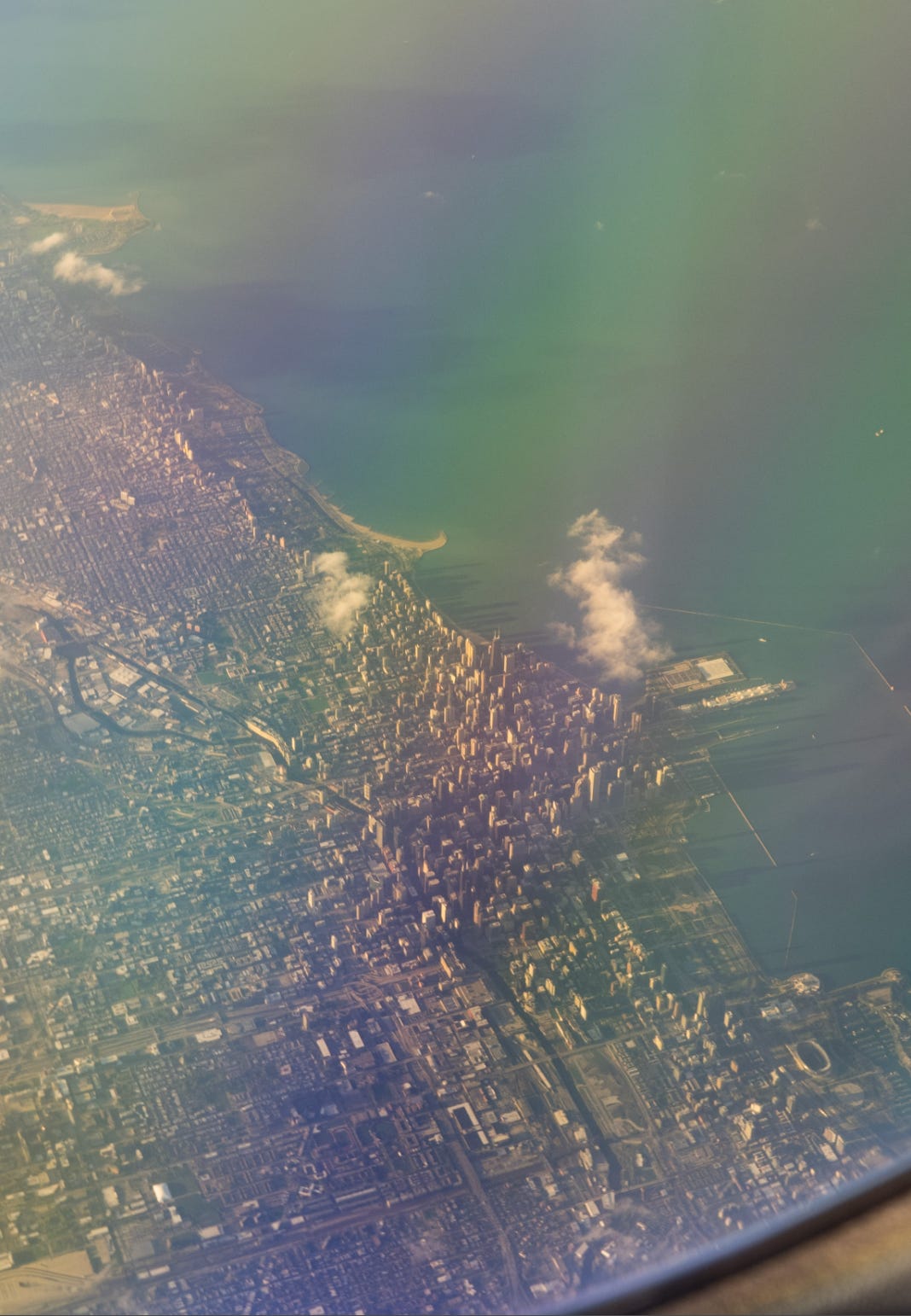
Looking down, we can see the windy city bathed in golden light.
But it’s busy airspace, not convenient for identifying an aircraft!
What is the ICAO type code of this aircraft?
Puzzle by Logan, Bellingcat
1. Geolocation debut: A look into the way I think
From a young age I have enjoyed attempting to decipher where it is we are cruising over every time I look out of the plane window. Luckily, the challenges set by the world leading researchers at Bellingcat have allowed me to use this as practise as I start getting to grips with the technical side of Open Source Intelligence. Here is a breakdown of my thought process behind decoding this puzzle.
However, the first thing worth saying is that the puzzle isn't quite what it looks like. An aerial city shot looks like a geolocation challenge, but the setter has already given you the location as the windy city, confirmed by the unmistakable curve of Lake Michigan and Navy Pier jutting out to the east. The question is the aircraft.
So you have to read the setter's text carefully, because one line is doing real work: "But it's busy airspace, not convenient for identifying an aircraft!" That isn't a throwaway, it is in fact a steer. Chicago sits under one of the busiest stretches of US airspace, with O'Hare and Midway between them feeding dozens of aircraft overhead at any given moment. If your instinct is to pull historical ADS-B data and find your match, the setter is telling you you'll drown in candidates.
So the question shifts: not where am I, but what does the image tell me about the aircraft I'm sitting in?
2. Calibrating the variant
I spent the first minute looking at the image without touching a tool. Two things stood out.
The first was the shadows. Building shadows in the photo cast in a clear direction, a textbook way to derive sun azimuth, then time of day, then which flights were overhead. I noted it. But the setter’s hint had already pre-empted that route: with Chicago’s airspace, even a tight time window leaves too many candidates. So I parked it.
The second thing was the colour, and this is the one which as it turns out, that actually mattered. There’s a distinct blue-purple cast across the image, most obvious on the right-hand side, over Lake Michigan, where the water and sky shade into a tint that doesn’t match any weather or lighting condition I could rationalise. And the cast wasn’t uniform: it sat more heavily on the right of the frame than the left. A camera tint or filter would have been uniform. A weather phenomenon would have followed the sky, not pooled over half the image.
That left one explanation. Whatever was producing the tint, it wasn’t outside the aircraft. It was the window itself. And that meant this wasn’t an ordinary airliner window, only the type of window I had seen on my ultra long haul flights to Singapore, Sydney and Mumbai, which was suddenly an interesting thing to know.
3. The Search
I went to Yandex and tried the kind of query you reach for when you have absolutely no idea what you’re looking at: blue tinted aircraft window, aircraft window dimming, purple aircraft window. The hits all pointed at the same thing, electrochromic windows.
The technology is Gentex’s, and it replaces the physical sliding sunshade with a window that dims through a sequence of tints, light blue to dark blue to deep purple, controlled by a small button at the seat. The viewer looks through it; the photographer sees it tint the world.
The aircraft most associated with it, by some distance, is the Boeing 787 Dreamliner. The 787 was the first airliner designed around electrochromic dimming as standard, and it’s one of its signature passenger-experience features. The same windows appear in some Bombardier Global and Gulfstream business jets, so the universe of candidates is short but not unique.
4. Ruling out the alternatives
Electrochromic windows alone don’t narrow this to the 787, they appear on a handful of business jet types too. So I had to use the rest of the image to triage what was left.
Three things pointed away from a business jet and toward an airliner. The vantage: you can see Chicago’s entire shoreline, Navy Pier, the river and a wide stretch of suburbs in one frame, which is a classic wide-body cruise angle from somewhere around 35,000 feet. The window: the curvature and proportion at the bottom-left of the image fit an airliner cabin window, not the smaller, more rounded oval of a Bombardier Global or Gulfstream. The context: a major-city @geolocate puzzle of this kind almost always lands on a mainstream commercial type, that’s just my intuition rather than any evidence, but it’s where the population of likely answers concentrates.
That left the Boeing 787 family, with high confidence.
5. Ruling out the alternatives
This is where the writeup either gets brave or evasive, and the analytical move is to do neither.
The 787 has three variants:
787-8 →
B788787-9 →
B789787-10 →
B78X
They share the same fuselage diameter and window pattern. From a single image, no engine, wing or registration in frame, the specific variant cannot be confirmed visually. So the honest answer has two parts: high confidence in the family, lower confidence in the variant.
For the variant I committed to B789. That’s not a wild guess. A simple Yandex/Google search tell me that by 2026 the 787-9 is by some distance the most-produced and most-flown variant globally, most major operators fly more -9s than -8s or -10s. The probability-weighted call is the -9, and the right thing to do is name it, commit to it, and acknowledge what the image alone couldn’t tell you.
6. The Results and Takeaways
The answer was B789 as it turns out, a 787-9, correct.
Four things this case taught me, worth holding onto:
Read the question. When the location is given to you, it isn’t a geolocation puzzle, however much it looks like one. The discipline of the puzzle changes and so does the toolkit.
Read the setter’s hints. “Busy airspace, not convenient for identifying an aircraft” wasn’t a complaint about flight tracking, it was actually a steer toward visual identification.
Test the alternative explanations explicitly. A uniform tint across the image would have been the camera. An uneven one wasn’t. Naming the alternative and ruling it out is more rigorous than just asserting the answer you want.
Calibrate. “787 family, variant uncertain, best guess B789” is stronger than “B789, confident.” Confidence matched to evidence is the analyst’s habit; overstating can read as just guessing.
I’m publishing these as I work them, methodology-led, with the wrong turns left in to showcase my exploration of the different branches of OSINT.
More to come.